01
Customer record
- What happened
- What happens next
- Current stage and progress
- Customer-visible updates and proof
Whoever Records / Murphy’s First Shift
A completed demonstration call becomes a private draft the owner can review, correct, and choose to publish. That working loop—not the promise of a future feature—is what is on trial here.
Fictional shop and call. Actual Records product.
The working loop
Actual product capture
These are the working customer and owner surfaces from the Storm Call demonstration. Open either one and inspect it directly.
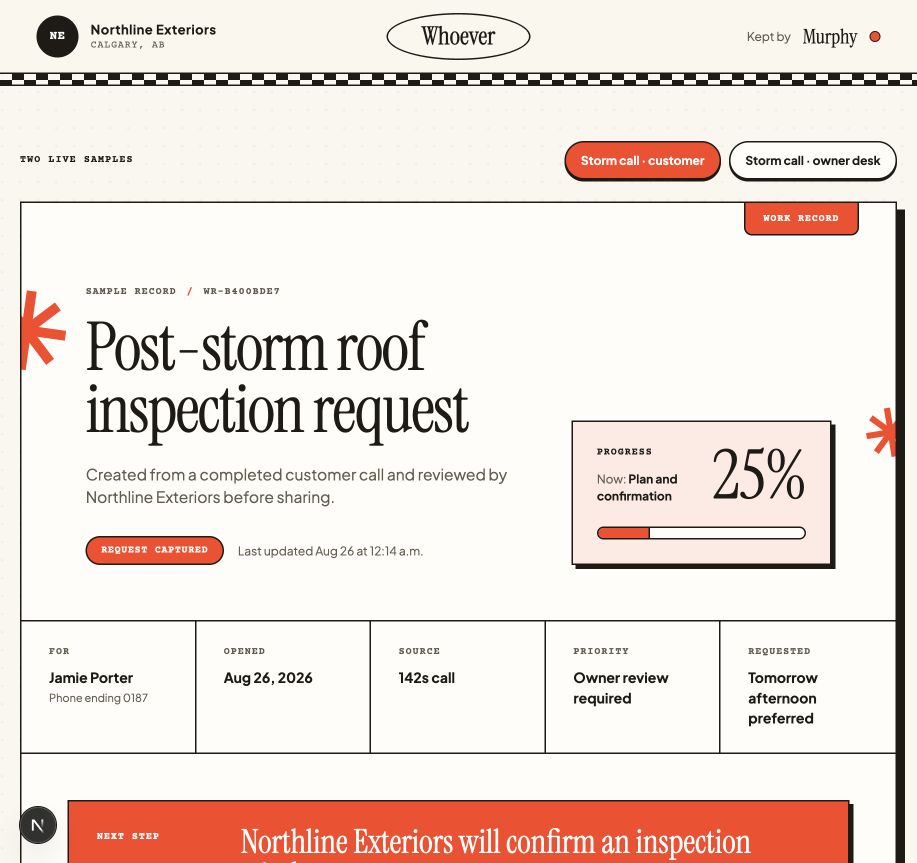
The shareable story: progress, request, next step, and the record the customer follows.
Open actual view ↗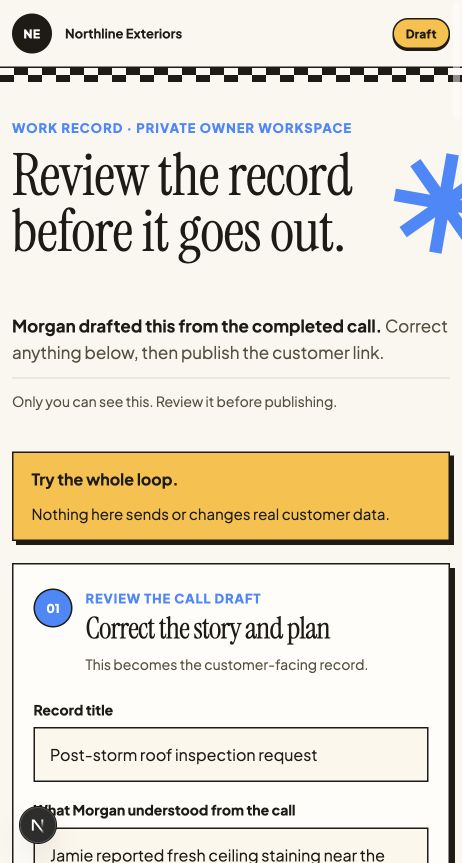
The private control surface: correct the draft, keep team-only context, and decide what goes out.
Open actual desk ↗Two desks by design
01
02
What this proves
The sample proves that a completed call can become a reviewable draft, that the owner can correct it before sharing, and that the customer and owner views stay distinct.
What it does not prove yet
This page does not claim she can already answer, qualify, book, route, or text back correctly for your shop. Those behaviours belong in the next test, with your real rules.
Your first-shift brief
Bring one real call path: what the customer asks, what Murphy may say, what she must never promise, who gets escalated, and what a clean handoff looks like. That becomes the audition.
Bring one call. A real situation beats a list of abstract features.
Write the boundaries. Service area, escalation, pricing, and unknowns.
Listen before hiring. Murphy takes the test; the business judges the work.
Keep the receipts. The record shows what happened after the call.
First Shift · Work sample 001